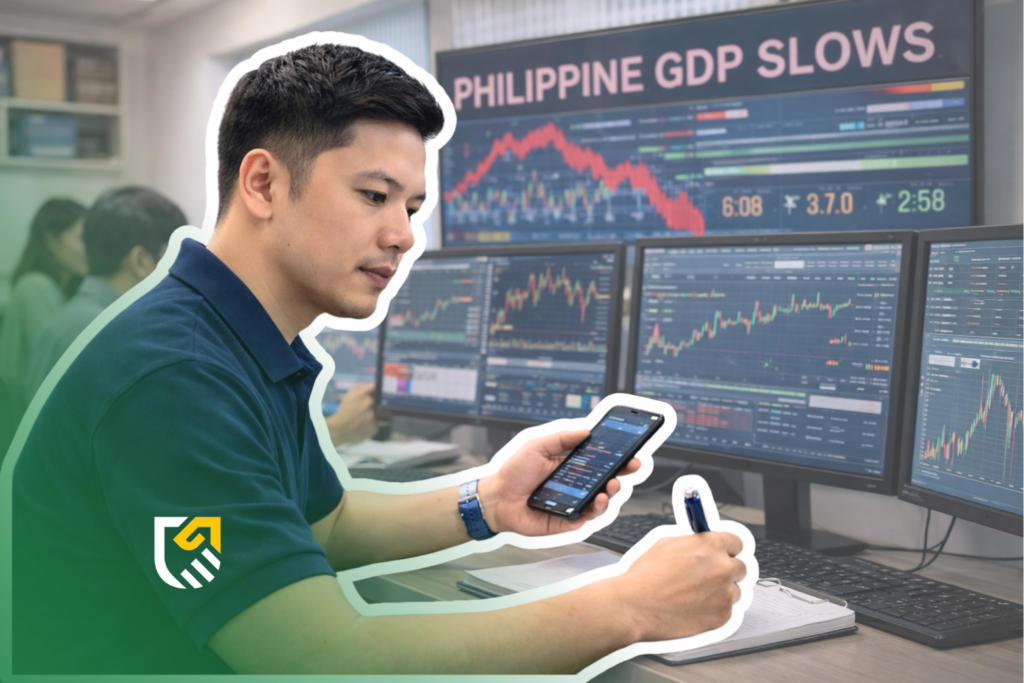
When news reports mention that economic growth has slowed, many retail investors immediately feel uneasy. Gross Domestic Product (GDP) measures overall economic activity. When it grows more slowly than expected, it signals that business activity and consumer spending may not be as strong as before.
In 2025, Philippine growth showed signs of weaker momentum compared to earlier targets. For everyday investors, this naturally raises concerns. Slower growth can bring worries about job security, consumer demand, company earnings, and even stock prices. It is easy to assume that if the economy slows, the market must follow.
But that assumption is not always accurate. And understanding the difference can change how you respond.
What Slower Growth Really Means for the Market
GDP is a broad economic measure. It tells us how the economy is moving overall, but it does not directly predict what individual stocks will do. Markets react to many factors, including company performance, interest rates, investor sentiment, and global developments.
Some sectors may feel the impact of slower growth more than others. Consumer-focused businesses might experience softer demand, while defensive sectors or companies with strong balance sheets may remain steady. Certain industries may even benefit if interest rates adjust in response to slower economic conditions.
This is why it is important not to treat GDP data as a direct signal to buy or sell. It is context, not a command.
Common Reactions That Often Hurt More Than Help
When growth data turns soft, retail investors often fall into predictable patterns. Some sell immediately out of fear, locking in losses without reviewing fundamentals. Others step aside entirely, waiting indefinitely for “perfect” conditions that may never arrive. A few may jump into whatever sector is suddenly trending, hoping to outpace uncertainty.
These reactions are emotional responses to headlines, not strategic decisions. Acting out of fear or excitement can derail long-term plans. Markets move in cycles, and reacting to every data release increases the chance of missing opportunities.
Remaining steady during uncertainty often matters more than reacting quickly.
A More Practical Way to Respond
Instead of focusing only on macro headlines, investors can shift their attention to what they can control. Reviewing sector performance helps determine which industries are holding up and which are under pressure. Looking closely at company fundamentals provides insight into whether a stock remains aligned with long-term goals.
Rebalancing gradually can also help manage exposure without making drastic moves. Adjustments do not need to happen overnight. Measured decisions allow investors to stay engaged without overreacting to short-term data.
This approach transforms uncertainty into an opportunity to reassess strategy calmly.
Why Knowledge Builds Confidence During Slowdowns
Confidence does not come from ignoring the news. It comes from understanding it. When investors learn how to interpret economic data properly, headlines lose their power to trigger panic.
Basic investing skills, such as analyzing company performance and reading market trends, act as filters. They help separate noise from meaningful signals. Instead of reacting emotionally, informed investors evaluate how new information fits into their existing strategy.
Education is what turns uncertainty into clarity.
Turning Headlines Into Insight with UTrade
UTrade supports investors by offering educational resources that focus on both fundamentals and technical analysis. These webinars and tools help retail investors understand how economic data connects to company performance and market movement.
Rather than relying on headlines alone, investors learn how to assess sectors, review portfolios, and apply economic context to their goals. The objective is not to predict every market move, but to make decisions grounded in understanding.
When growth slows, strategy matters more than speed. And with the right knowledge, investors can move forward with confidence instead of fear.
UTrade, is the online stock trading platform of Unicapital Securities, Inc., which offers smooth online stock trading and investing. With real-time market access, customizable layouts, and comprehensive charting, our platform provides convenience and a wide range of investment options, including stocks and mutual funds.
Unicapital Securities, Inc. (USI), under the Unicapital Group of companies, is a leading brokerage house duly licensed by the Securities and Exchange Commission and is a member of the Philippine Stock Exchange.